Handcrafted Wedding Bands for Los Angeles Weddings: What to Look For and Where to Shop
Picking a Wedding Band in LA Is More Complicated Than It Looks
Los Angeles couples have no shortage of jewelers competing for their attention — boutiques in the Downtown Jewelry District on Hill Street, destination studios in Silver Lake, and a growing number of online specialists who ship worldwide. The sheer volume of options tends to obscure a more practical problem: most people walk into the search without a clear framework for evaluating what they’re actually buying.
A handcrafted wedding band is a different product category from a mass-produced one. The metal choices, setting styles, stone certifications, and production timelines all interact in ways that affect both the final look and the long-term wearability of the ring. Getting those decisions right — especially when ordering remotely — requires knowing what questions to ask before you place any deposit.
This guide covers the four things that matter most: metal type, setting style, IGI certification for stone-set bands, and custom production timelines. By the end, you should be able to evaluate any jeweler’s offering with a clear head.
Metal Type: The Decision That Shapes Everything Else
The metal you choose for a wedding band determines its color, durability, weight, and — critically — whether it can be resized later. For LA couples, lifestyle tends to be a stronger driver than tradition. Someone who surfs in Malibu on weekends has different needs than someone who works in a Culver City office.
Platinum is the premium choice for long-term durability and holds its white color without the need for rhodium plating. It tends to develop a patina over time rather than scratching in the conventional sense — metal displaces rather than flakes, so material is rarely lost. The trade-off is price: platinum commands a significant premium over 18k gold.
14k gold remains the most versatile option across both boutiques and online retailers. It strikes a balance between hardness and workability that makes it suitable for most setting styles, and it’s available in yellow, white, and rose. For couples who want the look of precious metal without the premium price, 14k gold in various colors remains the most versatile option across both LA boutiques and high-volume retailers. White gold is rhodium-plated at the factory, which means it will need replating every few years to maintain its bright finish — something worth factoring into long-term care.
18k gold offers a richer color than 14k, particularly noticeable in yellow and rose variants, but is slightly softer. For eternity-style bands with pavé or channel-set stones, 18k is a common choice among handcrafted jewelers because it allows for cleaner prong work.
For anyone drawn to alternative metals, platinum is the premium choice for long-term durability but commands a significant price premium over 18k gold, while titanium and cobalt are worth serious consideration for active lifestyles where ring integrity under physical stress matters. The important caveat with most alternative metals: most alternative metals cannot be resized — if your finger size changes, you’ll likely need a total replacement rather than a simple adjustment. For a ring you plan to wear for decades, that’s a meaningful constraint.
Mixed-metal designs are also gaining ground in 2026. Mixed-metal designs are not just for engagement rings anymore. In 2026, two-tone wedding bands — think yellow gold inlay framed by platinum, or a rose gold band with white gold edging — are gaining serious traction. They are especially smart for couples who want their wedding band to play well with future stacking, or for blending heirloom jewelry with new pieces.
Setting Styles: What Works for a Wedding Band
The setting style on a stone-set wedding band is not purely aesthetic — it directly affects how the stones are protected, how much light they catch, and how the band wears against an engagement ring if you’re stacking the two.
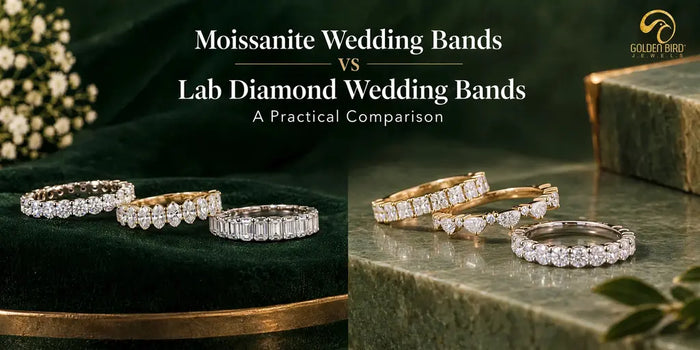
Pavé and channel settings are the workhorses of the diamond wedding band. Pavé involves small stones set close together with minimal metal between them, creating a near-continuous surface of sparkle. Channel setting places stones in a recessed groove between two raised metal walls, offering more protection with a cleaner profile. Channel-set bands tend to sit more flush against an engagement ring, which matters if the two pieces will be worn together daily.
Bezel settings have become a popular choice for modern LA couples, particularly for those who lead active lifestyles. Bezel moissanite rings are excellent for daily wear because their smooth, enclosed design protects the stone from impacts and scratches. They blend durability with sophisticated style, suitable for any activity. The trade-off is that the metal rim reduces the amount of light entering the stone from the side — a minor optical difference, but noticeable in direct comparison.
Eternity bands — where stones run continuously around the full circumference — are a distinct commitment. They cannot be resized, because cutting the band to add or remove metal would destroy the stone arrangement. Half-eternity bands, where stones cover only the top half of the ring, solve the resizing problem while preserving most of the visual effect.
Finish also plays a larger role in 2026 than it did even three years ago. The glossy mirror finish is no longer the default. Couples are gravitating toward hammered, brushed, satin, and matte finishes that feel more organic and handcrafted. These textures are especially popular for men’s bands, where they add personality without overcomplicating the design. Matte and brushed finishes hide scratches better than high polish, so they age more gracefully through everyday wear.
IGI Certification: Why It Matters for Stone-Set Bands
If you’re buying a wedding band with lab-grown diamonds — whether a pavé eternity band or a single-stone accent band — the certification attached to those stones is the primary tool for verifying what you’re actually paying for.
IGI (International Gemological Institute) is the most widely used grading body for lab-grown diamonds, and its reports follow the same 4Cs framework used for mined stones. An IGI-certified diamond is independently graded for quality and authenticity by the International Gemological Institute. This certification provides a detailed assessment of a diamond’s quality based on criteria such as cut, color, clarity, and carat weight, as well as ensuring authenticity.
For a wedding band specifically, the certification question is more nuanced than for a solitaire engagement ring. Pavé-set bands often use stones smaller than 0.10ct each, and individual IGI reports for stones that small are uncommon — the cost would be prohibitive. What you should look for instead is a jeweler who can confirm the overall quality parameters of the melee stones used (color and clarity grades) and who sources from graded lots. For any accent stone above 0.50ct, an individual IGI certificate is reasonable to request.
For lab-grown diamond eternity bands or bands with a meaningful center stone, the certificate matters for insurance appraisal purposes as well. The certificate itself doesn’t impact the price, but it adds value by providing transparency. Certified diamonds are easier to trust, compare, and resell compared to uncertified ones.
Moissanite, by contrast, is not graded by IGI or GIA in the same way — it’s a distinct gemstone (silicon carbide rather than carbon) and is assessed primarily for cut, color, and clarity by the manufacturer. Lab-grown diamonds rank 10 on the Mohs hardness scale, making them extremely scratch-resistant. Moissanite comes in at 9.25–9.5, still remarkably durable for everyday wear. This minimal difference in hardness means both stones will resist scratching through decades of wear. The optical difference is more pronounced: moissanite displays more fire — colorful flashes — than lab-grown diamonds. This extra sparkle can be eye-catching in various lighting conditions. Lab-grown diamonds have a different optical performance, with white light reflection that many find appealing. Neither is inherently superior; it comes down to the look you want.
Custom Timelines: How Long Does a Handcrafted Band Actually Take?
This is probably the most common planning mistake LA couples make: assuming a handcrafted band can be ordered a few weeks before the wedding. In most cases, that window is too tight.
Standard delivery time for custom bands averages 4 to 6 weeks after order placement. Timing depends on design complexity and jeweler workload, so ordering well in advance of your wedding date is essential. More intricate designs — mixed metals, custom engraving, unusual stone shapes, or eternity settings with hand-set stones — can push that timeline to 8–12 weeks. The whole process usually lasts between 4 to 12 weeks.
The custom process typically runs in four stages: an initial consultation where you establish the design parameters; a CAD or sketch review where you approve the design before production begins; fabrication, which is where the actual handcraft time sits; and finishing, which includes setting stones, polishing, and quality inspection. The process of creating custom wedding bands involves four steps: a complimentary price quote, a beautifully sketched concept design, the formation of computerized CAD models, and a final approval that gives the team the go-ahead to cast the design into precious metal. As the custom process requires a fine-tuned attention to detail, unique custom wedding rings take four to eight weeks to complete.
For couples with a firm wedding date, the practical advice is to start the band process at the same time as the engagement ring, or at minimum three months before the ceremony. For those with time constraints, initiating the planning process three months prior to the proposal or wedding deadline is strongly recommended. Rush services exist but typically add cost and may limit design options.
One detail that catches people off guard: ring sizing for wide bands is different from sizing for narrow bands. A 6mm or 8mm band sits differently on the finger than a 2mm band, and comfort-fit profiles — where the inner surface is slightly domed — can also shift the effective size. Getting sized with a band that matches your intended width is worth the extra step.
Where to Shop: What to Look for in an Online Jeweler
For LA-based couples, the local jewelry district offers the obvious advantage of seeing pieces in person. But the handcrafted lab-grown diamond and moissanite segment has largely moved online, where specialist jewelers can offer more design flexibility, better stone sourcing, and more transparent pricing than most brick-and-mortar boutiques.
When evaluating any online jeweler for a handcrafted wedding band, four things are worth checking before you commit to a deposit: whether they provide clear stone certification documentation; whether they offer CAD or photo approval before the piece ships; what their resizing and return policy looks like for custom pieces; and whether they have verifiable customer reviews that reference the custom process specifically, not just the final product.
Golden Bird Jewels is a strong option for couples who want handcrafted moissanite or IGI-certified lab-grown diamond wedding bands with genuine customization. Their moissanite wedding band collection covers eternity bands, bezel-set styles, channel-set designs, and dainty stackable bands — with metal options across yellow gold, white gold, rose gold, and platinum. Golden Bird Jewels offers custom moissanite bands where you can choose metal type, setting, and stone style. For couples who want the IGI-certified lab-grown diamond route, their lab-grown wedding band collection includes pavé and eternity styles built with the same handcrafted approach. Golden Bird Jewels shares clear photos or videos of your ring before shipping to ensure you’re happy with every detail of your purchase — which is exactly the kind of pre-shipment approval step that matters when you can’t see the piece in person.
The broader point for LA couples shopping online: the best handcrafted jewelers tend to communicate proactively throughout the production process, not just at the beginning and end. If a jeweler can’t tell you where your ring is in production when you ask, that’s usually a sign of a less hands-on operation. For a piece you’ll wear every day for the rest of your life, that communication quality is as important as the metalwork itself.