Lab Grown Diamond vs Moissanite Wedding Bands: The Best Choice for Los Angeles Couples

Two Stones, One Very Different Answer
Couples shopping for wedding bands in Los Angeles in 2026 are landing on the same shortlist: lab-grown diamonds and moissanite. Both skip the mine entirely. Both look stunning on the finger. Both cost a fraction of what mined diamonds command. But they are not interchangeable, and the choice you make will affect how the ring looks under the California sun, what it costs, and how it holds up over decades of daily wear.
The honest answer is that neither stone is objectively better. What changes is which one is better for you — and that depends on a specific set of priorities that most jewelers don’t walk you through clearly enough.
This guide does exactly that. It covers the numbers, the optics, the ethics, and the practical reality of wearing each stone every day in Los Angeles — one of the most style-conscious wedding markets in the country, with an estimated 50,634 weddings taking place in 2026 alone.
The Price Gap Is Real — But It’s Narrowing
Start with cost, because it shapes every other decision.
A 1-carat moissanite stone typically runs $300–$600, while a comparable 1-carat lab-grown diamond lands between $800 and $1,500 depending on cut, color, and clarity grade. Scale up to 3 carats and the gap widens sharply: a lab-grown oval in that size can reach $2,000–$3,500, while the moissanite equivalent comes in around $900–$1,300.
But here’s what’s shifted in 2026: lab-grown diamond prices have dropped 50–70% since 2021, which means the once-dramatic cost advantage of moissanite has compressed. A few hundred dollars more now buys you an actual, IGI-certified diamond — and for couples in the 1–2 carat range especially, that premium has become genuinely modest.
Moissanite’s pricing also behaves differently as size increases. Unlike lab diamonds, which are evaluated on the 4Cs (cut, color, clarity, carat) and priced with exponential jumps as carat weight rises, moissanite scales more gently. A 2-carat moissanite rarely exceeds $800, making it the clear choice for couples who want maximum visual presence on a defined budget.
Quick price comparison (approximate 2026 retail):
| Stone | 1 Carat | 2 Carat | 3 Carat |
|---|---|---|---|
| Moissanite | $300–$600 | $600–$800 | $900–$1,300 |
| Lab-Grown Diamond | $800–$1,500 | $1,500–$2,500 | $2,000–$3,500 |
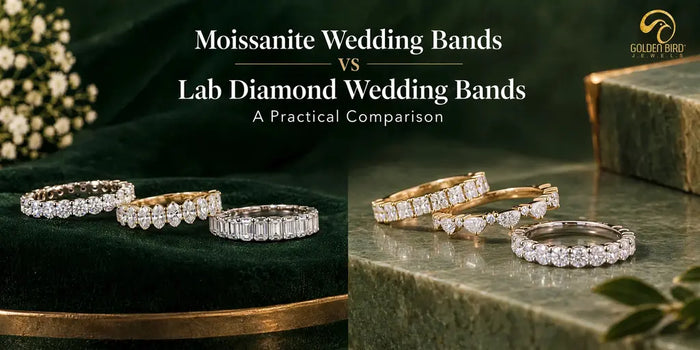
For wedding bands specifically — where stones are typically smaller and set in a continuous row rather than as a single statement piece — the per-stone cost difference tends to be less dramatic than in engagement rings. A moissanite eternity band and a lab-grown diamond eternity band can sit surprisingly close in price at the same millimeter width, which is worth factoring in before assuming moissanite is always the budget choice.
Sparkle: What the Numbers Actually Mean
This is where the two stones diverge most visibly, and where most comparison guides get vague.
Lab-grown diamonds are singly refractive with a refractive index of 2.42. Light travels through them in a clean, direct path, producing the crisp white brilliance that most people picture when they think of a diamond. The sparkle is balanced and classic — it reads as a diamond because it is one, chemically and optically identical to a mined stone.
Moissanite has a refractive index of 2.65–2.69 and a dispersion value of 0.104, compared to diamond’s 0.044. In practical terms, that means moissanite produces roughly 2.5 times more colorful “fire” — those rainbow-colored flashes — than a diamond of the same size. It’s also doubly refractive, meaning light splits as it enters the stone, creating what some describe as a kaleidoscope effect.
In dim indoor lighting, a well-cut moissanite and a lab-grown diamond can look nearly identical. In direct California sunlight or under bright venue lighting, the difference becomes visible — moissanite throws off noticeably more rainbow color, particularly in stones over 1 carat. Some couples love this. Others find it reads as “not quite a diamond” to people who know what to look for.
Which sparkle is right for you?
| Factor | Moissanite | Lab-Grown Diamond |
|---|---|---|
| Refractive Index | 2.65–2.69 | 2.42 |
| Fire (Dispersion) | 0.104 — intense rainbow flashes | 0.044 — subtle, elegant |
| Light Behavior | Doubly refractive (kaleidoscope) | Singly refractive (classic white) |
| Mohs Hardness | 9.25 | 10 |
| Looks Like a Diamond? | Very similar indoors; distinct outdoors | Identical — because it is one |
For wedding bands, where stones are typically smaller and set closer together, the fire difference between the two is less pronounced than in a solitaire engagement ring. A moissanite eternity band and a lab-grown diamond pave band can look strikingly similar in most lighting conditions — which is a useful thing to know if you’re stacking a band against an existing ring.
Ethics and Certification: Both Score Well, With One Difference
Neither stone requires mining, which eliminates the conflict-diamond supply chain concerns that drove many couples toward alternatives in the first place. Both moissanite and lab-grown diamonds are produced in controlled laboratory environments, with no association with conflict or exploitative labor practices.
Where they differ is in certification infrastructure. Lab-grown diamonds are graded by IGI and GIA using the same 4C criteria applied to mined diamonds — cut, color, clarity, and carat. An IGI certificate for a lab-grown diamond provides a detailed, independently verified grading report that documents exactly what you’re buying. This matters for insurance, resale, and simply for confidence in your purchase.
Moissanite, by contrast, is not graded within the established diamond certification ecosystem in the same way. It’s typically sold by millimeter dimensions rather than carat weight, and while reputable sellers provide quality documentation, there’s no equivalent to an IGI or GIA grading report.
On the environmental side, both stones require energy-intensive production. The carbon footprint of a lab-grown diamond depends significantly on the energy source used — a producer running on renewable energy has a genuinely lower environmental impact than a conventional mining operation. Buyers who care about this specifically should ask their jeweler about production methods and energy sourcing, not just assume “lab-made” automatically means “green.”
Golden Bird Jewels carries IGI-certified lab-grown diamonds alongside its moissanite collection, which means buyers who want formal certification documentation have that option available when shopping their wedding band collection.
Durability for Daily Wear in Los Angeles
Both stones are well-suited for daily wear, which matters for wedding bands more than almost any other piece of jewelry — these rings don’t come off.
Lab-grown diamonds score a perfect 10 on the Mohs hardness scale, making them the hardest known material. Moissanite scores 9.25, which is still harder than sapphire and more than adequate for everyday wear including active lifestyles. The practical difference between a 9.25 and a 10 is negligible for most people — neither stone will scratch under normal conditions.
For Los Angeles couples who spend time outdoors, at the beach, or in active environments, both stones hold up well. The setting style probably matters more to long-term durability than the stone itself — a bezel-set band protects the stone more effectively than a prong setting regardless of whether it’s moissanite or diamond.
The Recommendation: Match the Stone to the Priority
There’s no universal right answer, but there are clear patterns.
Choose a lab-grown diamond wedding band if:
- You want a stone that is chemically and optically a diamond, with no visible difference from a mined stone
- IGI or GIA certification matters to you for insurance or peace of mind
- You’re in the 1–2 carat range, where the price premium over moissanite has narrowed significantly
- You want formal grading documentation that travels with the ring
Choose a moissanite wedding band if:
- Budget is the primary constraint and you want the maximum stone size for the money
- You prefer the higher-fire, more colorful sparkle profile
- You’re going larger than 2 carats, where moissanite’s gentler price scaling becomes a real financial advantage
- You’re stacking multiple bands and want to keep total cost manageable
For couples who are undecided, the wedding band context itself is worth noting: because bands typically feature smaller stones set in rows rather than a single large center stone, the visual and price differences between the two options are less dramatic than in an engagement ring. Many couples end up choosing moissanite for the band and lab-grown diamond for the engagement ring, or vice versa, without any obvious mismatch.
In 2026, with lab-grown diamond prices continuing to fall and moissanite offering its own distinct optical personality, neither choice is a compromise. Both are legitimate, beautiful options for couples who want ethical, handcrafted jewelry that doesn’t carry the weight of the mining industry.
Golden Bird Jewels handcrafts both moissanite and lab-grown diamond wedding bands, with options ranging from moissanite eternity bands to IGI-certified diamond pave bands — all available with custom metal choices and design adjustments. For Los Angeles couples who want to see the full range before committing to one stone or the other, browsing both collections side by side is the most practical starting point.